Picture 1 of 2

Gallery
Picture 1 of 2


Have one to sell?
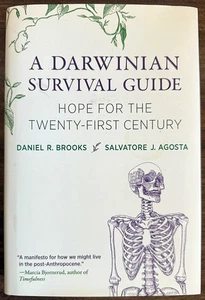
A Darwinian Survival Guide: Hope for the Twenty-First Century Brooks, Daniel...

US $17.95
ApproximatelyS$ 23.26
or Best Offer
Condition:
Oops! Looks like we're having trouble connecting to our server.
Refresh your browser window to try again.
Shipping:
US $5.95 (approx S$ 7.71) Economy Shipping.
Located in: Pocatello, Idaho, United States
Delivery:
Estimated between Tue, 9 Dec and Fri, 12 Dec to 94104
Returns:
No returns accepted.
Coverage:
Read item description or contact seller for details. See all detailsSee all details on coverage
(Not eligible for eBay purchase protection programmes)
About this item
Seller assumes all responsibility for this listing.
eBay item number:389276613756
Item specifics
- Condition
- Brand New: A new, unread, unused book in perfect condition with no missing or damaged pages. See all condition definitionsopens in a new window or tab
- Release Year
- 2024
- ISBN
- 9780262048682
About this product
Product Identifiers
Publisher
MIT Press
ISBN-10
026204868X
ISBN-13
9780262048682
eBay Product ID (ePID)
21060629114
Product Key Features
Book Title
Darwinian Survival Guide : Hope for the Twenty-First Century
Number of Pages
360 Pages
Language
English
Topic
Life Sciences / Evolution, Ecology, Global Warming & Climate Change
Publication Year
2024
Genre
Nature, Science
Format
Hardcover
Dimensions
Item Height
1.3 in
Item Weight
21.2 Oz
Item Length
9.3 in
Item Width
6.4 in
Additional Product Features
Intended Audience
Trade
LCCN
2023-002410
TitleLeading
A
Dewey Edition
23/eng/20230929
Reviews
"Timely, thought-provoking, and refreshingly optimistic. . . . Applying the principles of evolution in thoughtful ways, A Darwinian Survival Guide tackles the complexities of climate change with creativity, optimism, and vision." -- Foreword Reviews
Dewey Decimal
304.2
Table Of Content
CONTENTS PREFACE vii 1 INTRODUCTION 1 2 HOW DOES NATURE WORK? INHERITANCE SYSTEMS 15 3 HOW DOES NATURE WORK? ECOSYSTEMS 39 4 HUMANS: THE EARLY DAYS 59 5 THE LATE PLEISTOCENE: THE RISE OF HOMO SAPIENS 79 6 AFTER THE ICE AGE: THE GREAT TRANSITION 89 7 THE NEOLITHIC PERIOD: THE GREAT AMPLIFICATION 101 8 INSTITUTIONALIZING SOCIETY: THE GREAT TRAGEDY 117 9 OVERSPENDING AS A WAY OF LIFE: INFLECTION AND ACCELERATION 145 10 HOW HUMANS SHOULD INTERACT WITH THE REST OF THE BIOSPHERE 165 11 CONVIVIAL CONSERVATION IN AN EVOLUTIONARY COMMONS: COSTA RICA'S GREEN PHOENIX 193 12 HOW HUMANS SHOULD INTERACT WITH EACH OTHER 205 13 HOW HUMANS SHOULD INTERACT WITH THEIR INSTITUTIONS 231 14 AUTUMN OF THE ANTHROPOCENE: HOPE FOR NOW, HOPE FOR THE FUTURE 255 ACKNOWLEDGMENTS 271 SELECTED READINGS 273 INDEX 335
Synopsis
How humanity brought about the climate crisis by departing from its evolutionary trajectory 15,000 years ago-and how we can use evolutionary principles to save ourselves from the worst outcomes. Despite efforts to sustain civilization, humanity faces existential threats from overpopulation, globalized trade and travel, urbanization, and global climate change. In A Darwinian Survival Guide , Daniel Brooks and Salvatore Agosta offer a novel-and hopeful-perspective on how to meet these tremendous challenges by changing the discourse from sustainability to survival. Darwinian evolution, the world's only theory of survival, is the means by which the biosphere has persisted and renewed itself following past environmental perturbations, and it has never failed, they explain. Even in the aftermath of mass extinctions, enough survivors remain with the potential to produce a new diversified biosphere. Drawing on their expertise as field biologists, Brooks and Agosta trace the evolutionary path from the early days of humans through the Late Pleistocene and the beginning of the Anthropocene all the way to the Great Acceleration of technological humanity around 1950, demonstrating how our creative capacities have allowed humanity to survive. However, constant conflict without resolution has made the Anthropocene not only unsustainable, but unsurvivable. Guided by the four laws of biotics, the authors explain how humanity should interact with the rest of the biosphere and with each other in accordance with Darwinian principles. They reveal a middle ground between apocalypse and utopia, with two options- alter our behavior now at great expense and extend civilization or fail to act and rebuild in accordance with those same principles. If we take the latter, then our immediate goal ought to focus on preserving as many of humanity's positive achievements-from high technology to high art-as possible to shorten the time needed to rebuild., How humanity brought about the climate crisis by departing from its evolutionary trajectory 15,000 years ago--and how we can use evolutionary principles to save ourselves from the worst outcomes. Despite efforts to sustain civilization, humanity faces existential threats from overpopulation, globalized trade and travel, urbanization, and global climate change. In A Darwinian Survival Guide , Daniel Brooks and Salvatore Agosta offer a novel--and hopeful--perspective on how to meet these tremendous challenges by changing the discourse from sustainability to survival. Darwinian evolution, the world's only theory of survival, is the means by which the biosphere has persisted and renewed itself following past environmental perturbations, and it has never failed, they explain. Even in the aftermath of mass extinctions, enough survivors remain with the potential to produce a new diversified biosphere. Drawing on their expertise as field biologists, Brooks and Agosta trace the evolutionary path from the early days of humans through the Late Pleistocene and the beginning of the Anthropocene all the way to the Great Acceleration of technological humanity around 1950, demonstrating how our creative capacities have allowed humanity to survive. However, constant conflict without resolution has made the Anthropocene not only unsustainable, but unsurvivable. Guided by the four laws of biotics, the authors explain how humanity should interact with the rest of the biosphere and with each other in accordance with Darwinian principles. They reveal a middle ground between apocalypse and utopia, with two options: alter our behavior now at great expense and extend civilization or fail to act and rebuild in accordance with those same principles. If we take the latter, then our immediate goal ought to focus on preserving as many of humanity's positive achievements--from high technology to high art--as possible to shorten the time needed to rebuild.
LC Classification Number
GF41.B778 2024
Item description from the seller

Seller feedback (5,046)
- o***n (811)- Feedback left by buyer.Past monthVerified purchaseAs described, a RARE, huge, antique (131 yrs. old!) German book with 71 big, colorful butterfly & moth plates; Fast shipping & friendly communication; Very securely packed as requested; This seller offers a large collection of rare/hard-to-find natural history (entomology) books & many other nature based interesting items; Thank you from a repeat Canadian Customer!
- s***1 (27)- Feedback left by buyer.Past 6 monthsVerified purchaseI placed my order on the 11th and it was delivered on the 13th! It arrived professionally packed. The item that I ordered was correctly described with no surprises! I would encourage anyone to order from this site. The price was very reasonable for the quality of the item.Bernina 707 MINIMATIC SEWING MACHINE, Foot Pedal, Case, Manual, & Accessories! (#116710916232)
- 1***9 (4896)- Feedback left by buyer.Past 6 monthsVerified purchaseAn exceptional Seller and one of Ebay's best! Books were described very well along with pictures, Lightening fast shipping way beyond expectations, took extra care in packaging very heavy antique books in strong box with padding to prevent damage and ensure safe delivery. Thank you, Much appreciated!Lydekker 1910 HARMSWORTH NATURAL HISTORY V.III BIRDS FISH INSECTS INVERTS COLOR (#116705813686)
Seller feedback (5,046)
- o***n (811)- Feedback left by buyer.Past monthVerified purchaseAs described, a RARE, huge, antique (131 yrs. old!) German book with 71 big, colorful butterfly & moth plates; Fast shipping & friendly communication; Very securely packed as requested; This seller offers a large collection of rare/hard-to-find natural history (entomology) books & many other nature based interesting items; Thank you from a repeat Canadian Customer!
- s***1 (27)- Feedback left by buyer.Past 6 monthsVerified purchaseI placed my order on the 11th and it was delivered on the 13th! It arrived professionally packed. The item that I ordered was correctly described with no surprises! I would encourage anyone to order from this site. The price was very reasonable for the quality of the item.Bernina 707 MINIMATIC SEWING MACHINE, Foot Pedal, Case, Manual, & Accessories! (#116710916232)
- 1***9 (4896)- Feedback left by buyer.Past 6 monthsVerified purchaseAn exceptional Seller and one of Ebay's best! Books were described very well along with pictures, Lightening fast shipping way beyond expectations, took extra care in packaging very heavy antique books in strong box with padding to prevent damage and ensure safe delivery. Thank you, Much appreciated!Lydekker 1910 HARMSWORTH NATURAL HISTORY V.III BIRDS FISH INSECTS INVERTS COLOR (#116705813686)