Picture 1 of 8


Gallery
Picture 1 of 8


Have one to sell?
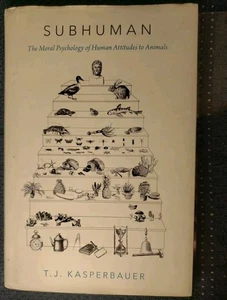
Subhuman: The Moral Psychology of Human Attitudes to Animals, Kasperbauer T.J

US $14.99
ApproximatelyS$ 19.43
or Best Offer
Condition:
Oops! Looks like we're having trouble connecting to our server.
Refresh your browser window to try again.
Pickup:
Free local pickup from Fort Wayne, Indiana, United States.
Shipping:
US $4.00 (approx S$ 5.19) USPS Media MailTM.
Located in: Fort Wayne, Indiana, United States
Delivery:
Estimated between Tue, 16 Dec and Wed, 24 Dec to 94104
Returns:
30 days return. Buyer pays for return shipping. If you use an eBay shipping label, it will be deducted from your refund amount.
Coverage:
Read item description or contact seller for details. See all detailsSee all details on coverage
(Not eligible for eBay purchase protection programmes)
About this item
Seller assumes all responsibility for this listing.
eBay item number:317504324191
Item specifics
- Condition
- Personalized
- No
- ISBN
- 9780190695811
About this product
Product Identifiers
Publisher
Oxford University Press, Incorporated
ISBN-10
0190695811
ISBN-13
9780190695811
eBay Product ID (ePID)
239553754
Product Key Features
Number of Pages
264 Pages
Language
English
Publication Name
Subhuman : the Moral Psychology of Human Attitudes to Animals
Publication Year
2018
Subject
Ethics & Moral Philosophy, Animals / General, Animal Rights
Type
Textbook
Subject Area
Nature, Philosophy
Format
Hardcover
Dimensions
Item Height
0.9 in
Item Weight
12.8 Oz
Item Length
5.7 in
Item Width
8.3 in
Additional Product Features
Intended Audience
Scholarly & Professional
LCCN
2017-021975
Reviews
"Subhuman will provide a fascinating read for any educated reader, and especially for students of philosophy and psychology, even if you do not agree with some of the book's founding claims. I recommend it highly for anyone interested in a satisfying foray into human/animal relations." -- Wendy C. Hamblet, Metapsychology Online Reviews "Our relation to animals is among the most important and, at the same time, the most puzzling moral questions of our time: We love our pets and spend countless hours in zoos and aquariums while allowing the disappearance of too many species and the suffering to too many animals. By bringing cutting-edge psychology to systematically bear on this moral question, Kasperbauer's superb book, Subhuman, revolutionizes our understanding of our relation to animals. It is also a deep and important contribution to moral psychology." --Edouard Machery, Distinguished Professor of History and Philosophy of Science, University of Pittsburgh "Subhuman is a call to action for animal ethicists. Kasperbauer's theory about infrahumanization is of immense significance, not least for conversations about the ethics of competing advocacy strategies, the difficult task of cause prioritization, and the relationship between animal advocacy and other social justice movements. We've long needed a book like this, and there's plenty of work to be done in its wake." --Bob Fischer, Department of Philosophy, Texas State University, "Our relation to animals is among the most important and, at the same time, the most puzzling moral questions of our time: We love our pets and spend countless hours in zoos and aquariums while allowing the disappearance of too many species and the suffering to too many animals. By bringing cutting-edge psychology to systematically bear on this moral question, Kasperbauer's superb book, Subhuman, revolutionizes our understanding of our relation to animals. It is also a deep and important contribution to moral psychology." --Edouard Machery, Distinguished Professor of History and Philosophy of Science, University of Pittsburgh "Subhuman is a call to action for animal ethicists. Kasperbauer's theory about infrahumanization is of immense significance, not least for conversations about the ethics of competing advocacy strategies, the difficult task of cause prioritization, and the relationship between animal advocacy and other social justice movements. We've long needed a book like this, and there's plenty of work to be done in its wake." --Bob Fischer, Department of Philosophy, Texas State University, "Our relation to animals is among the most important and, at the same time, the most puzzling moral questions of our time: We love our pets and spend countless hours in zoos and aquariums while allowing the disappearance of too many species and the suffering to too many animals. By bringing cutting-edge psychology to systematically bear on this moral question, Kasperbauer's superb book, Subhuman, revolutionizes our understanding of our relation to animals. It is also a deep and important contribution to moral psychology." --Edouard Machery, Distinguished Professor of History and Philosophy of Science, University of Pittsburgh, "...offers a helpful critique..." -- A.G. Holdier, Journal of Moral Philosophy"Subhuman will provide a fascinating read for any educated reader, and especially for students of philosophy and psychology, even if you do not agree with some of the book's founding claims. I recommend it highly for anyone interested in a satisfying foray into human/animal relations." -- Wendy C. Hamblet, Metapsychology Online Reviews"Our relation to animals is among the most important and, at the same time, the most puzzling moral questions of our time: We love our pets and spend countless hours in zoos and aquariums while allowing the disappearance of too many species and the suffering to too many animals. By bringing cutting-edge psychology to systematically bear on this moral question, Kasperbauer's superb book, Subhuman, revolutionizes our understanding of our relation to animals. It is also a deep and important contribution to moral psychology." --Edouard Machery, Distinguished Professor of History and Philosophy of Science, University of Pittsburgh "Subhuman is a call to action for animal ethicists. Kasperbauer's theory about infrahumanization is of immense significance, not least for conversations about the ethics of competing advocacy strategies, the difficult task of cause prioritization, and the relationship between animal advocacy and other social justice movements. We've long needed a book like this, and there's plenty of work to be done in its wake." --Bob Fischer, Department of Philosophy, Texas State University, "...offers a helpful critique..." -- A.G. Holdier, Journal of Moral Philosophy "Subhuman will provide a fascinating read for any educated reader, and especially for students of philosophy and psychology, even if you do not agree with some of the book's founding claims. I recommend it highly for anyone interested in a satisfying foray into human/animal relations." -- Wendy C. Hamblet, Metapsychology Online Reviews "Our relation to animals is among the most important and, at the same time, the most puzzling moral questions of our time: We love our pets and spend countless hours in zoos and aquariums while allowing the disappearance of too many species and the suffering to too many animals. By bringing cutting-edge psychology to systematically bear on this moral question, Kasperbauer's superb book, Subhuman, revolutionizes our understanding of our relation to animals. It is also a deep and important contribution to moral psychology." --Edouard Machery, Distinguished Professor of History and Philosophy of Science, University of Pittsburgh "Subhuman is a call to action for animal ethicists. Kasperbauer's theory about infrahumanization is of immense significance, not least for conversations about the ethics of competing advocacy strategies, the difficult task of cause prioritization, and the relationship between animal advocacy and other social justice movements. We've long needed a book like this, and there's plenty of work to be done in its wake." --Bob Fischer, Department of Philosophy, Texas State University, "...offers a helpful critique..." -- A.G. Holdier, Journal of Moral Philosophy"Subhuman will provide a fascinating read for any educated reader, and especially for students of philosophy and psychology, even if you do not agree with some of the book's founding claims. I recommend it highly for anyone interested in a satisfying foray into human/animal relations." -- Wendy C. Hamblet, Metapsychology Online Reviews"Our relation to animals is among the most important and, at the same time, the most puzzling moral questions of our time: We love our pets and spend countless hours in zoos and aquariums while allowing the disappearance of too many species and the suffering to too many animals. By bringing cutting-edge psychology to systematically bear on this moral question, Kasperbauer's superb book, Subhuman, revolutionizes our understanding of our relation to animals. Itis also a deep and important contribution to moral psychology." --Edouard Machery, Distinguished Professor of History and Philosophy of Science, University of Pittsburgh"Subhuman is a call to action for animal ethicists. Kasperbauer's theory about infrahumanization is of immense significance, not least for conversations about the ethics of competing advocacy strategies, the difficult task of cause prioritization, and the relationship between animal advocacy and other social justice movements. We've long needed a book like this, and there's plenty of work to be done in its wake." --Bob Fischer, Department of Philosophy, TexasState University
Dewey Edition
23
Illustrated
Yes
Dewey Decimal
179.3
Table Of Content
1. Introduction 2. Evolved Attitudes to Animals 3. Dehumanizing Animals 4. Dehumanization and Mentalizing Animals 5. Diagnosing Moral Failures 6. Psychological Plausibility for Animal Ethics 7. Animals and the Expanding Moral Circle 8. Managing Moral Psychology for Animal Ethics Acknowledgements References
Synopsis
How do we think about animals? How do we decide what they deserve and how we ought to treat them? Subhuman takes an interdisciplinary approach to these questions, drawing from research in philosophy, neuroscience, psychology, law, history, sociology, economics, and anthropology. Subhuman argues that our attitudes to nonhuman animals, both positive and negative, largely arise from our need to compare ourselves to them., When Harambe, a now-famous gorilla at the Cincinnati zoo, was shot for endangering a small child, animal rights activists protested, calling into question moral reasoning that privileges the possibility of injury to a human over definite violence to an animal. Many others, though less vehement in their objection, voiced the same questions: was the gorilla any worse than the negligent parents? Doesn't Harambe have rights just like you and me?How do we decide what animals deserve and how we ought to treat them? To what extent are our attitudes towards animals embedded in our subconscious and immune to reason? The foundations of our moral attitudes to animals are more complex than many may appreciate. Subhuman takes an interdisciplinary approach to these questions, drawing from research in philosophy, neuroscience, psychology, law, history, sociology, economics, and anthropology, to unearth surprising revelations about human relationships with animals. T.J. Kasperbauer argues provocatively that behind our positive and negative attitudes to animals is an enduring concern that animals pose a threat to our humanness. Namely, our need to ensure animals' inferiority to human beings affects both our kindness and cruelty to animals. Kasperbauer develops this idea by looking at research on the phenomenon of dehumanization, revealing that our attitudes to other humans are predicted and reflected in our treatment of other species. In making his case, Kasperbauer provides a critical survey of leading theories that range over the role of animals in human evolutionary history, the psychology of meat-eating and keeping pets, feelings of fear and disgust toward animals, the use of animal minds to determine their moral status, and the "expanding moral circle" hypothesis. By exploring the psychological obstacles humans face in meeting ethical demands, Kasperbauer sets forth new and fascinating ways of thinking about our moral obligations to animals, and how we might correct them., When Harambe, a now-famous gorilla at the Cincinnati Zoo, was shot for endangering a small child, animal rights activists protested, calling into question moral reasoning that privileges the possibility of injury to a human over definite violence to an animal. Many others, though less vehement in their objection, voiced the same questions: was the gorilla any worse than the negligent parents? Doesn't Harambe have rights just like you and me? How do we decide what animals deserve and how we ought to treat them? To what extent are our attitudes towards animals embedded in our subconscious and immune to reason? The foundations of our moral attitudes to animals are more complex than many may appreciate. Subhuman takes an interdisciplinary approach to these questions, drawing from research in philosophy, neuroscience, psychology, law, history, sociology, economics, and anthropology, to unearth surprising revelations about human relationships with animals. T.J. Kasperbauer argues provocatively that behind our positive and negative attitudes to animals is an enduring concern that animals pose a threat to our humanness. Namely, our need to ensure animals' inferiority to human beings affects both our kindness and cruelty to animals. Kasperbauer develops this idea by looking at research on the phenomenon of dehumanization, revealing that our attitudes to other humans are predicted and reflected in our treatment of other species. In making his case, Kasperbauer provides a critical survey of leading theories that range over the role of animals in human evolutionary history, the psychology of meat-eating and keeping pets, feelings of fear and disgust toward animals, the use of animal minds to determine their moral status, and the "expanding moral circle" hypothesis. By exploring the psychological obstacles humans face in meeting ethical demands, Kasperbauer sets forth new and fascinating ways of thinking about our moral obligations to animals, and how we might correct them., When Harambe, a now-famous gorilla at the Cinncinnati zoo, was shot for endangering a small child, animal rights activists protested, calling into question moral reasoning that privileges the possibility of injury to a human over definite violence to an animal. Many others, though less vehement in their objection, voiced the same questions: was the gorilla any worse than the negligent parents? Doesn't Harambe have rights just like you and me?How do we decide what animals deserve and how we ought to treat them? To what extent are our attitudes towards animals embedded in our subconscious and immune to reason? The foundations of our moral attitudes to animals are more complex than many may appreciate. Subhuman takes an interdisciplinary approach to these questions, drawing from research in philosophy, neuroscience, psychology, law, history, sociology, economics, and anthropology, to unearth surprising revelations about human relationships with animals. T.J. Kasperbauer argues provocatively that behind our positive and negative attitudes to animals is an enduring concern that animals pose a threat to our humanness. Namely, our need to ensure animals' inferiority to human beings affects both our kindness and cruelty to animals. Kasperbauer develops this idea by looking at research on the phenomenon of dehumanization, revealing that our attitudes to other humans are predicted and reflected in our treatment of other species. In making his case, Kasperbauer provides a critical survey of leading theories that range over the role of animals in human evolutionary history, the psychology of meat-eating and keeping pets, feelings of fear and disgust toward animals, the use of animal minds to determine their moral status, and the "expanding moral circle" hypothesis. By exploring the psychological obstacles humans face in meeting ethical demands, Kasperbauer sets forth new and fascinating ways of thinking about our moral obligations to animals, and how we might correct them.
LC Classification Number
B105.A55K37 2018
Item description from the seller

Popular categories from this store
Seller feedback (78)
- i***b (212)- Feedback left by buyer.Past monthVerified purchaseGreat seller! Shipped quickly, carefully packaged, and just as described. Thank you so much again!!! A+++++
- 6***i (27)- Feedback left by buyer.Past monthVerified purchaseSeller was friendly and communicative. Item was delivered fast and arrived as described.
- d***. (207)- Feedback left by buyer.Past monthVerified purchaseArrived quickly and well packaged. Item was exactly as described — thanks for a pleasant transaction!
Popular categories from this store
Seller feedback (78)
- i***b (212)- Feedback left by buyer.Past monthVerified purchaseGreat seller! Shipped quickly, carefully packaged, and just as described. Thank you so much again!!! A+++++
- 6***i (27)- Feedback left by buyer.Past monthVerified purchaseSeller was friendly and communicative. Item was delivered fast and arrived as described.
- d***. (207)- Feedback left by buyer.Past monthVerified purchaseArrived quickly and well packaged. Item was exactly as described — thanks for a pleasant transaction!