Picture 1 of 7


Gallery
Picture 1 of 7


Have one to sell?
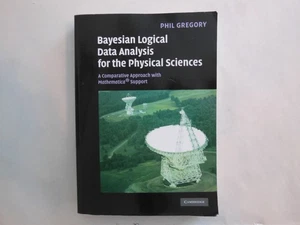
Bayesian Logical Data Analysis for the Physical Sciences : A Comparative...
US $12.00
ApproximatelyS$ 15.55
Condition:
“Minor wear to the cover but the pages are clean”
Oops! Looks like we're having trouble connecting to our server.
Refresh your browser window to try again.
Shipping:
Free USPS Media MailTM.
Located in: Allen, Texas, United States
Delivery:
Estimated between Mon, 8 Dec and Thu, 11 Dec to 94104
Returns:
30 days return. Buyer pays for return shipping. If you use an eBay shipping label, it will be deducted from your refund amount.
Coverage:
Read item description or contact seller for details. See all detailsSee all details on coverage
(Not eligible for eBay purchase protection programmes)
About this item
Seller assumes all responsibility for this listing.
eBay item number:277502219406
Item specifics
- Condition
- Good
- Seller Notes
- “Minor wear to the cover but the pages are clean”
- Educational Level
- Adult & Further Education
- Personalized
- No
- Level
- Intermediate
- Country of Origin
- United States
- ISBN
- 9780521841504
About this product
Product Identifiers
Publisher
Cambridge University Press
ISBN-10
052184150X
ISBN-13
9780521841504
eBay Product ID (ePID)
12038708116
Product Key Features
Number of Pages
488 Pages
Publication Name
Bayesian Logical Data Analysis for the Physical Sciences : A Comparative Approach with Mathematica Support
Language
English
Publication Year
2005
Subject
Probability & Statistics / General, General
Type
Textbook
Subject Area
Mathematics, Science
Format
Hardcover
Dimensions
Item Height
1.1 in
Item Weight
37.4 Oz
Item Length
10 in
Item Width
7 in
Additional Product Features
Intended Audience
Scholarly & Professional
LCCN
2004-045930
Dewey Edition
22
Reviews
"The book can easily keep the readers amazed and attracted to its content throughout the read and make them want to return back to it recursively. It presents a perfect balance between theoretical inference and a practical know-how approach to Bayesian methods." Stan Lipovetsky, GfK Custom Research North America, Technometrics, 'The book can easily keep the readers amazed and attracted to its content throughout the read and make them want to return back to it recursively. It presents a perfect balance between theoretical inference and a practical know-how approach to Bayesian methods.' Stan Lipovetsky, Technometrics, 'As well as the usual topics to be found in a text on Bayesian inference, chapters are included on frequentist inference (for contrast), non-linear model fitting, spectral analysis and Poisson sampling.' Zentralblatt MATH, "All researchers and scientists who are interested in the Bayesian scientific paradigm can benefit greatly from the examples and illustrations here. It is a welcome addition to the vast literature on Bayesian inference." Sreenivasan Ravi, University of Mysore, Manasagangotri, ' ... a clearly written guide to applied statistical analysis by using SPSS software. it is filled with examples and exercises that help readers to understand the types of problem that the techniques can address. If you are an SPSS enthusiast, a beginner or not, you will find this new edition a satisfying source of valuable infromation.' Journal of the RSS
Illustrated
Yes
Dewey Decimal
519.542
Table Of Content
Preface; Acknowledgements; 1. Role of probability theory in science; 2. Probability theory as extended logic; 3. The how-to of Bayesian inference; 4. Assigning probabilities; 5. Frequentist statistical inference; 6. What is a statistic?; 7. Frequentist hypothesis testing; 8. Maximum entropy probabilities; 9. Bayesian inference (Gaussian errors); 10. Linear model fitting (Gaussian errors); 11. Nonlinear model fitting; 12. Markov Chain Monte Carlo; 13. Bayesian spectral analysis; 14. Bayesian inference (Poisson sampling); Appendix A. Singular value decomposition; Appendix B. Discrete Fourier transforms; Appendix C. Difference in two samples; Appendix D. Poisson ON/OFF details; Appendix E. Multivariate Gaussian from maximum entropy; References; Index.
Synopsis
Increasingly, researchers in many branches of science are coming into contact with Bayesian statistics or Bayesian probability theory. This book provides a clear exposition of the underlying concepts with large numbers of worked examples and problem sets. Background material is provided in appendices and supporting Mathematica® notebooks are available., Researchers in many branches of science are increasingly coming into contact with Bayesian statistics or Bayesian probability theory. This book provides a clear exposition of the underlying concepts with large numbers of worked examples and problem sets. It also discusses numerical techniques for implementing the Bayesian calculations, including Markov Chain Monte-Carlo integration and linear and nonlinear least-squares analysis seen from a Bayesian perspective., Bayesian inference provides a simple and unified approach to data analysis, allowing experimenters to assign probabilities to competing hypotheses of interest, on the basis of the current state of knowledge. By incorporating relevant prior information, it can sometimes improve model parameter estimates by many orders of magnitude. This book provides a clear exposition of the underlying concepts with many worked examples and problem sets. It also discusses implementation, including an introduction to Markov chain Monte-Carlo integration and linear and nonlinear model fitting. Particularly extensive coverage of spectral analysis (detecting and measuring periodic signals) includes a self-contained introduction to Fourier and discrete Fourier methods. There is a chapter devoted to Bayesian inference with Poisson sampling, and three chapters on frequentist methods help to bridge the gap between the frequentist and Bayesian approaches. Supporting Mathematica(r) notebooks with solutions to selected problems, additional worked examples, and a Mathematica tutorial are available at www.cambridge.org/9780521150125., Bayesian inference provides a simple and unified approach to data analysis, allowing experimenters to assign probabilities to competing hypotheses of interest, on the basis of the current state of knowledge. By incorporating relevant prior information, it can sometimes improve model parameter estimates by many orders of magnitude. This book provides a clear exposition of the underlying concepts with many worked examples and problem sets. It also discusses implementation, including an introduction to Markov chain Monte-Carlo integration and linear and nonlinear model fitting. Particularly extensive coverage of spectral analysis (detecting and measuring periodic signals) includes a self-contained introduction to Fourier and discrete Fourier methods. There is a chapter devoted to Bayesian inference with Poisson sampling, and three chapters on frequentist methods help to bridge the gap between the frequentist and Bayesian approaches. Supporting Mathematica® notebooks with solutions to selected problems, additional worked examples, and a Mathematica tutorial are available at www.cambridge.org/9780521150125., Bayesian inference provides a simple and unified approach to data analysis, allowing experimenters to assign probabilities to competing hypotheses of interest, on the basis of the current state of knowledge. By incorporating relevant prior information, it can sometimes improve model parameter estimates by many orders of magnitude. This book provides a clear exposition of the underlying concepts with many worked examples and problem sets. It also discusses implementation, including an introduction to Markov chain Monte-Carlo integration and linear and nonlinear model fitting. Particularly extensive coverage of spectral analysis (detecting and measuring periodic signals) includes a self-contained introduction to Fourier and discrete Fourier methods. There is a chapter devoted to Bayesian inference with Poisson sampling, and three chapters on frequentist methods help to bridge the gap between the frequentist and Bayesian approaches. Supporting Mathematica(R) notebooks with solutions to selected problems, additional worked examples, and a Mathematica tutorial are available at www.cambridge.org/9780521150125.
LC Classification Number
QA279.5 .G74 2005
Item description from the seller
Seller feedback (4,697)
- s***m (804)- Feedback left by buyer.Past monthVerified purchaseHB book was shipped from TX in a padded yellow bubble envelope via USPS Media Mail; arrived in VA in 6 days in rather good shape (as described). Thanks!
- n***p (167)- Feedback left by buyer.Past monthVerified purchaseExactly as described. Shipped very quickly & packaged well. Devoured this book in 3 days! Amazing seller
- m***1 (46)- Feedback left by buyer.Past monthVerified purchaseArrived quickly and in great condition. Good price and as described in listing. Packaged with care.